
Description
There are exactly two good reasons to buy an Azure account, and they belong to different people. Either your organisation already lives inside Microsoft’s world — Entra ID, Microsoft 365, .NET, Active Directory — and Azure removes friction that AWS never will. Or you need Azure OpenAI, and you have discovered that the front door to it is guarded.
This account handles both. Verified, subscription active, limits raised, AI reachable rather than pending.
Why Azure signup defeats people
Azure’s onboarding is arguably the most opaque of the three hyperscalers. The subscription activates while the services you wanted do not. Payment verification rejects cards that work everywhere else. Starter quotas make the platform feel like a demo of itself. And AI access — the reason most people arrive at Azure in 2026 — sits behind a request that can take days and can be refused without an explanation you can act upon.
It is fraud prevention working as designed and catching legitimate builders in the net. Understanding that does not ship your feature.
What is included
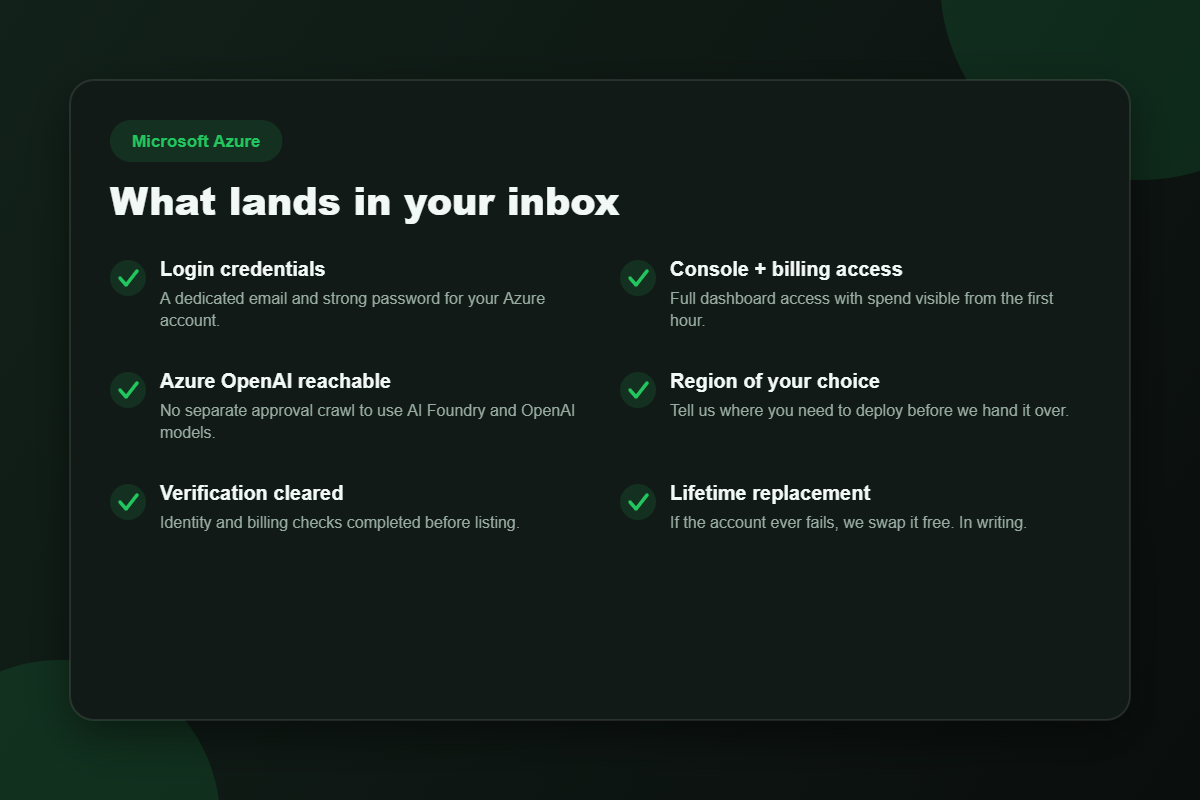
- Login credentials — dedicated email and strong password.
- Full portal and billing access, spend visible from the first hour.
- Azure OpenAI reachable — no separate approval crawl for AI Foundry and the OpenAI model family.
- Raised compute limits so your first deployment is not blocked by a starter quota.
- The region you need, configured before handover.
- Free lifetime replacement, in writing.
Tiers and pricing
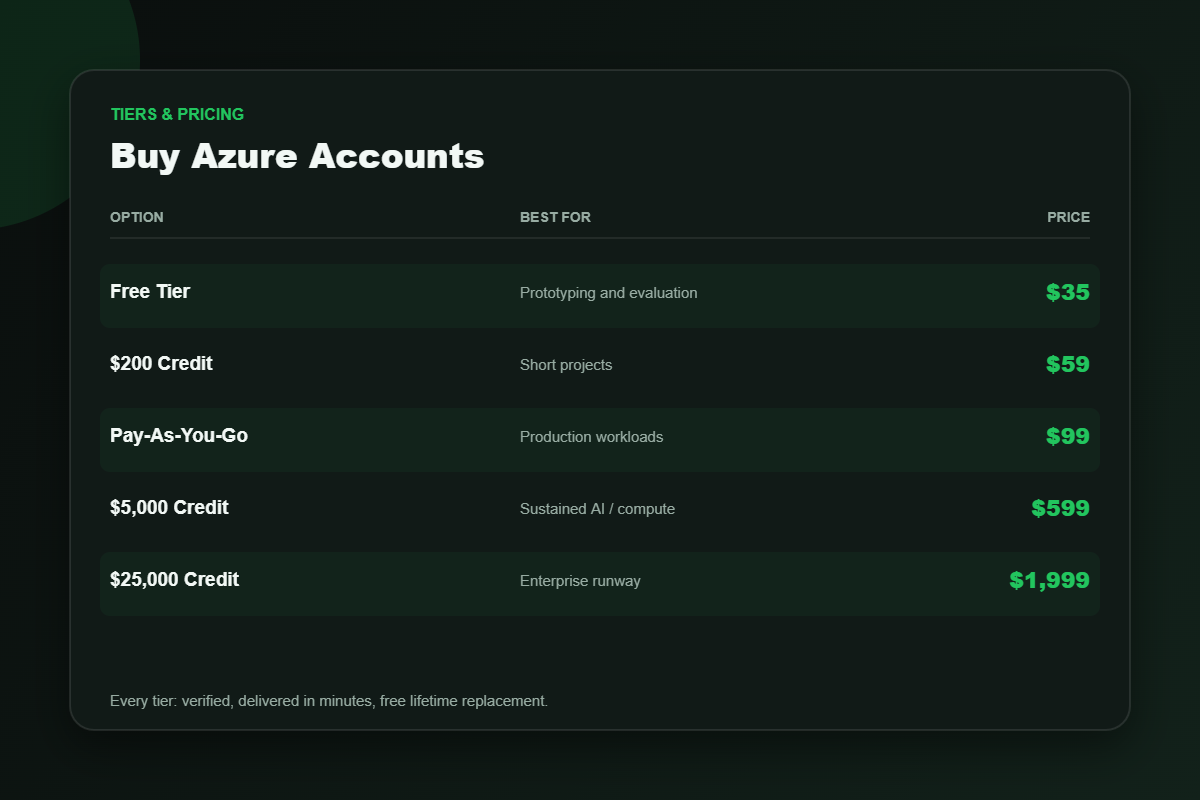
Free Tier — $35
Verified account on the free tier — for prototyping and for confirming Azure actually fits before you commit money.
$200 Credit — $59
A modest working balance. Enough for a short project or a serious proof of concept.
Pay-As-You-Go — $99
Active PAYG subscription, billing live, limits raised. The tier for production work.
$5,000 Credit — $599
Sustained AI or compute workloads. Azure OpenAI at volume moves the bill quickly, and preloaded credit is usually the cheaper way to buy that capacity.
$25,000 Credit — $1,999
Enterprise runway for long-horizon projects where infrastructure cost is a planning constraint.
When Azure is the wrong answer
If you are running a straightforward web application, an API and a database, Azure will do it — competently, expensively, through a portal that will occasionally make you want to lie down. Hetzner or DigitalOcean will do the same job for a fraction of the cost and a fraction of the cognitive overhead. We set that out honestly in our platform comparison, including the parts that cost us margin.
If you need the broadest service catalogue or you are hiring into an existing skill base, AWS is probably the better call.
Delivery and guarantees
Automated: median around ten minutes from cleared payment to a working portal, at any hour. If the account fails afterwards, message support and we replace it free — written into the order.
Account hygiene on day one
Whatever you buy, and from whoever, spend the first fifteen minutes on security rather than deployment.
- Change the password immediately and store it in a password manager.
- Turn on multi-factor authentication before anything else.
- Create a working user instead of operating as the administrator every day.
- Set a billing alert. Cheap is not free, and forgotten resources bill silently.
A seller who hands over credentials without mentioning any of this is not looking after you. Our buying guide lists every question worth asking a seller — including the ones we would rather you did not ask us.
Frequently asked questions
Is Azure OpenAI genuinely enabled?
The account is configured so AI services are reachable rather than pending. If you have a specific model or region requirement, tell us before ordering and we will confirm it explicitly rather than let you assume.
Can I attach my own Microsoft 365 tenant?
It depends on your setup. Describe it and we will tell you honestly whether this account fits or whether fixing your existing subscription is the better move.
How does it compare with AWS?
Different strengths, genuinely. AWS has breadth and community; Azure wins on Microsoft integration and OpenAI access. Neither is universally better and we do not pretend otherwise.
What if I picked the wrong platform?
Ask before you buy. That is the cheapest possible moment to be wrong.
Getting value out of an Azure subscription
Set a budget before you deploy
Azure will let you spend money you did not intend to spend, and the portal does not work hard to stop you. Open Cost Management and set a budget with an alert threshold before you launch anything. Four minutes, and it is the highest-value thing you can do with a new subscription.
Region choice is a cost decision, not just a latency one
Azure pricing varies meaningfully between regions for identical resources, and availability of the newest AI models varies more still. Choosing a region purely on latency can quietly cost you both money and capability. Tell us your requirements before delivery and we will configure a region that serves both.
Do not over-provision out of nerves
The urge to buy a larger tier “just in case” is understandable and usually wrong. Start where the workload actually sits, watch spend for a fortnight, then scale from evidence rather than anxiety. Outgrowing a tier is a good problem and an easy one to fix.
Why buy rather than sign up?
Azure is free to sign up for, so be clear about what you are actually purchasing: the days that verification, quota approval and AI access requests would otherwise consume, and certainty about an outcome the signup process does not guarantee. For a hobby project with no deadline that trade is probably not worth it. For a team with a sprint or an AI product that needs OpenAI access this month, it usually is.
Related
Compare with Google Cloud, Oracle Cloud or the AWS range. Browse all cloud accounts, or read the buying guide first.
Disclaimer: BuyAWSMarket.com is an independent reseller and is not affiliated with, authorized by, or endorsed by Microsoft Corporation. All trademarks belong to their respective owners. A cleared account saves you the verification queue; it does not transfer responsibility. You remain accountable for complying with the platform’s terms of service and for whatever you run on it.





Reviews
There are no reviews yet.